
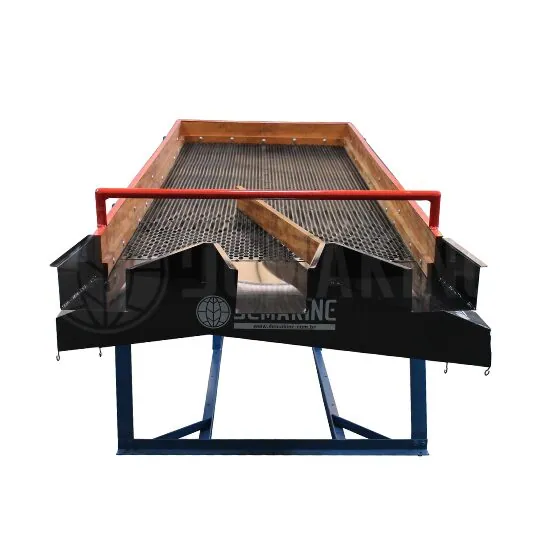
Real factory photos in sequence: hover over the image (or drag on your phone) to see the equipment from every angle.
Charcoal Screening and Packing Machine
The Charcoal Screen, or Charcoal Packing Machine, is essential for anyone who needs output and speed when packing and sorting charcoal. The machine works with two screens, an outlet spout for dust and chips, and two or three bagging spouts. Vibration comes from an eccentric shaft that moves the charcoal to the spout, making packing possible with even more quality. We also produce special models according to each customer's needs.
Applications
3 models available as standard, plus custom adaptations when your layout calls for them.
About the Charcoal Screening and Packing Machine
The Charcoal Screen, or Charcoal Packing Machine, is essential for anyone who needs output and speed when packing and sorting charcoal. The machine works with two screens, an outlet spout for dust and chips, and two or three bagging spouts. Vibration comes from an eccentric shaft that moves the charcoal to the spout, making packing possible with even more quality. We also produce special models according to each customer's needs.
Technical features
- System with two screens that separate charcoal, dust and chips
- Two or three bagging spouts, depending on the model
- Independent outlets for dust and for chips
- Output of 200 to 600 3 kg packs per hour
- 0.75 hp or 1 hp motor, in 110 or 220 V
- Switch included, installed off the machine because of vibration
- Bearing housings with grease fittings for lubrication
- Anchored to the floor, with an anchoring guide for each model
- Special custom-built models
- Mostly PU (polyurethane) paint
Specifications
Compare the 3 models
Factory reference values. Length, belt width and drive can be adjusted according to the project.
Same on every model
- Screens
- 2
- Dust outlet
- 1
- Chip outlet
- 1
- Infeed height
- 113 cm
- Outlet height
- 80 cm
- Voltage
- 110 or 220 V
PDM1
- Charcoal outlets
- 2
- Output
- 200 packs of 3 kg/h
- Dimensions
- 2000 x 750 mm
- Motor
- 0,75 cv
PDM2
- Charcoal outlets
- 2
- Output
- 400 packs of 3 kg/h
- Dimensions
- 2800 x 900 mm
- Motor
- 0,75 cv
PDM3
- Charcoal outlets
- 3
- Output
- 600 packs of 3 kg/h
- Dimensions
- 3000 x 1100 mm
- Motor
- 1 cv
Engineering tools
Do the math before requesting a quote
The same logic our engineering team uses every day, with the models from our real production table.
Compare the cost of handling by hand with the equipment.
How your operation is today
Assumptions used in the calculation, in plain sight: manual handling of 180 volumes per hour per person and conveyor at 2,000 volumes per hour (belt at 40 m/min, one volume every 1.2 m). Adjust the fields with the real numbers of your operation.
What changes with mechanization
Savings per month
R$7,600
Savings in 12 months
R$91,200
Estimated payback
enter the investment
Hours/month freed up
23 h
Monthly labor cost on this task
- Savings with the conveyorR$7,600−50%
- Cost that remainsR$7,600
| Daily time on the task | 1.7 h manual → 0.6 h with conveyor |
|---|---|
| Volumes per year | 316,800 |
| Labor cost per volume | R$0.58 → R$0.29 |
How it works
How the screen handles charcoal
It receives the charcoal, separates it by size and delivers three different outputs: charcoal ready for the pack, dust and chips. Each one leaves through its own spout.
- 01
Feeding
The charcoal enters through the infeed spout, 1.13 m above the floor, one piece after another, without overlapping.
- 02
Screening
Two screens vibrate, driven by the eccentric shaft, which grades the charcoal and pushes it to the spouts.
- 03
Picking
Dust and chips fall through their own outlets and do not mix with the good charcoal.
- 04
Bagging
The graded charcoal leaves through the bagging spouts, 80 cm above the floor, straight into the pack.
What comes out of the machine
- Charcoal for bagging2 spouts (PDM1 and PDM2) or 3 spouts (PDM3)
- Powder1 dedicated outlet
- Chips1 dedicated outlet
Output by model
3 kg packs per hour
- PDM1200
- PDM2400
- PDM3600
When operating
- Start the screen empty and only then begin feeding.
- Feed the charcoal piece by piece, without one on top of another.
- If a foreign object gets in or an unusual noise appears: switch off the motor immediately and check before restarting.
- At the end of the shift, leave the machine running until all the material has come out.
Source: Technical manual of the Demakine Charcoal Screening and Packing Machine
Maintenance checklist
Checklist for the Charcoal Screening and Packing Machine
Routine from the screen's technical manual. What matters most for its service life is the lubrication of the bearings, which work under vibration all the time.
0 of 6 items
Every month
- Lubricate the bearings through the grease fittings on the housings, with standard grease
See the manual for further information.
Periodically
- Watch the bearings: loud noise, vibration, heating or abnormal wear
- Keep the motor clean, with the ventilation free for the fan air to circulate
- Check the electrical connections and the motor mounting bolts
- Clean the structure with a soft-bristle brush or soft cloth, without alcohol or solvent
- Keep the electrical panel clean and inspected
See the manual for further information.
Always
- Carry out maintenance, cleaning and adjustment only with the screen stopped and switched off
- Keep the screen anchored to the floor according to the model's anchoring guide
Installation sheet
What to have ready before the machine arrives
When the site is prepared, the machine goes into operation on the day it arrives. This is the list we give customers when the order is closed.
- 1Bench or support at operator heightDefine the working height to reduce effort and improve the finish.
- 2Power point nearbySocket at the correct voltage, with no improvised extension cord.
- 3Space for the bag flowClear infeed and outfeed, so the operator does not have to turn the load by hand.
- 4Stock of thread and needlesHave consumables at the factory before starting production.
- 5Lighting at the sewing pointGood light on the bag mouth avoids a seam in the wrong place.
Before you buy
3 mistakes that cost dearly in this choice
These are the mismatches we see most in machines bought in a hurry. It costs little to check beforehand and a lot to fix afterwards.
Machine chosen without looking at the type of bag
Raffia, paper, laminated and valve bags call for different needle, stitch and thread. Tell us the actual bag you use.
Thread and needle out of specification
Half of loose-seam problems come from the wrong thread or a worn needle, not from the machine. Keeping the right thread and needle is what ensures a firm seam.
Workstation without support
Sewing with the bag in your hands tires the operator and the seam comes out crooked. A conveyor, table or cart at the right height changes the result of the shift.
After-sales
Spare parts and consumables
Wear items we supply for this line. Having the critical parts in stock before harvest is what separates a stoppage of hours from a stoppage of days.
Need a part now?
Tell us the equipment and, if you have it, send a photo of the part. The quote comes straight from technical service.
Frequently asked questions
What people ask most about this equipment line.
See all frequently asked questions →It handles the bags most used for feed, grain, fertilizer and food. Tell us the bag material and weight so we can confirm needle, thread and stitch.
Yes. We supply thread for bag sewing and spare parts for the machine.
Yes. It is the most common combination: a conveyor taking the bag to the sewing station and from there to the pallet or truck.
By WhatsApp, phone, e-mail or any form on the website. To speed things up, tell us the material conveyed, the distance to cover, the discharge height and the capacity you want. If you can send a photo or video of the site, the sizing will be more accurate.
Nothing leaves the factory without a running test. Larger equipment may arrive in parts for transport and is assembled on site following the guidance we send along.
Quote
Request a proposal for the Charcoal Screening and Packing Machine
To speed things up, tell us: material conveyed, length needed, discharge height and capacity wanted. If you have photos of the site, even better: send them on WhatsApp.
- Project sized for your operation
- Manufactured in-house in Limeira/SP, Brazil
- Delivery throughout Brazil
- Technical service and spare parts
Related equipment
Need custom-built equipment?
Send us the details of your operation: material, length, height and capacity. Our engineering team puts together the ideal solution and you get the quote within 1 business day.
(19) 3033-9397 · (19) 99884-2717 · vendas@demakine.com.br