
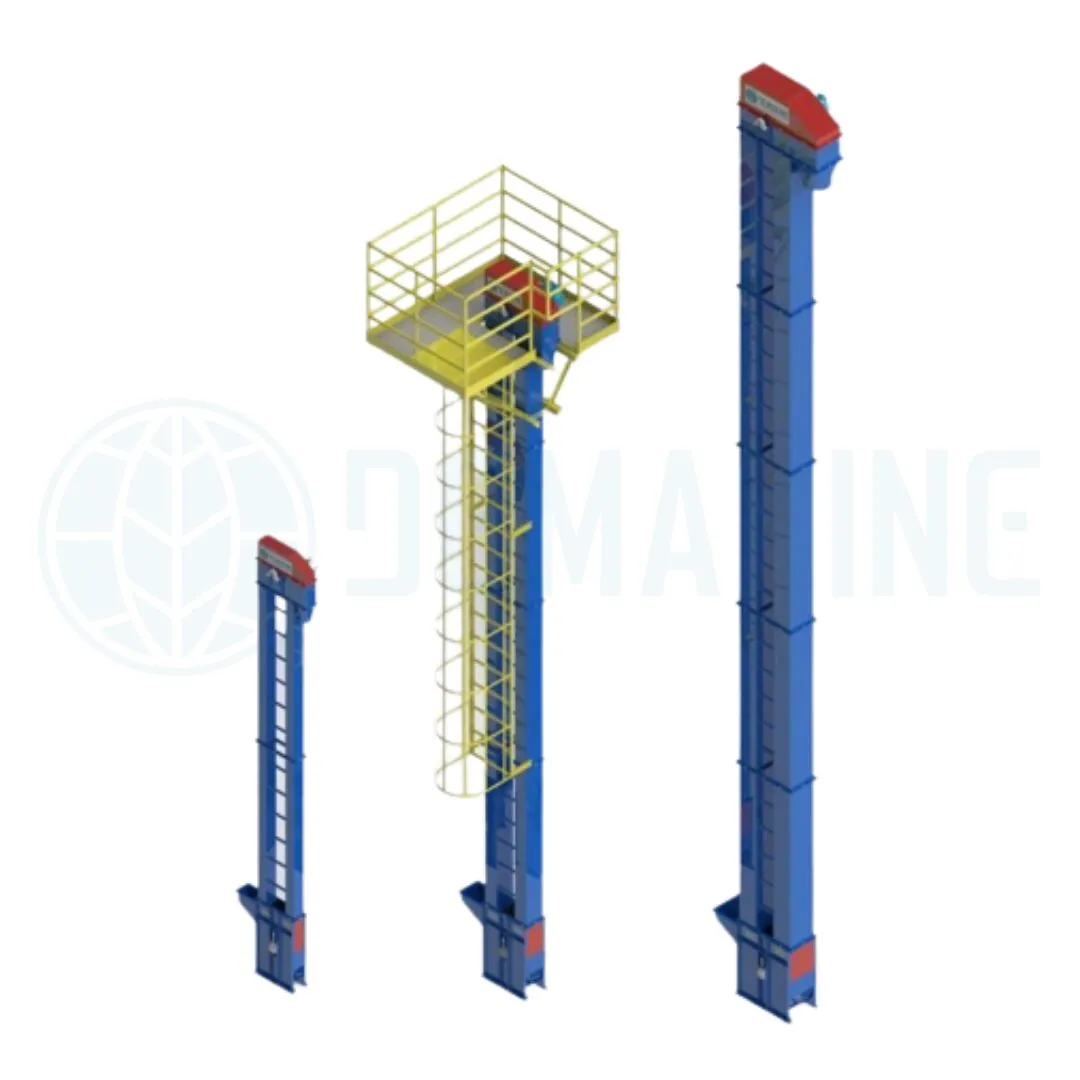
Real factory photos in sequence: hover over the image (or drag on your phone) to see the equipment from every angle.
Bucket Elevator
The bucket elevator is mainly used for the vertical conveying of bulk products such as grains (soybeans, corn, sugar, sand, stone, broken glass), pastes and wet products, sludge, clay, powder, products of varied particle size and density, products that disperse easily or that need to be isolated from the environment.
Applications
About the Bucket Elevator
The bucket elevator is mainly used for the vertical conveying of bulk products such as grains (soybeans, corn, sugar, sand, stone, broken glass), pastes and wet products, sludge, clay, powder, products of varied particle size and density, products that disperse easily or that need to be isolated from the environment.
Applications: Mining – coal, stone, iron ore, sand, lime, etc. Chemical – salts, sulfur, urea, fertilizers, sulfates, etc. Food – sugar, salt, flour, cocoa, cereals, etc. Effluent treatment – water and sewage. Ceramics and even construction – cement, concrete mix and sand with high moisture.
Material: they can be built in painted CARBON STEEL or in STAINLESS STEEL depending on the application
We build Bucket Elevators up to 30 meters high with capacity of up to 100 t/h. An elevator that is simple to operate and assemble, ensuring greater efficiency in handling your products.
Quality reference: we manufacture our Bucket Elevator in-house, giving our customers even more quality, along with a constant search for new technologies and materials that meet the market's current needs.
Equipment with a 12-month warranty!
Technical features
- Ensures efficient vertical conveying
- Savings in cost and floor space
- Tough plastic buckets (resistant to friction and moisture)
- Also known as a Grain Elevator or Grain Leg
- The modules between the head and the boot are 2 m long
- Transmission through gearmotors or pulleys; the electric drive can use frequency inverters
- 5 buckets per meter
- The shape and size of the buckets depend on the product (grain) to be conveyed
- The boot of the bucket elevator has clean-out drawers
- Every elevator has, in one of its modules, a window for maintenance and bucket replacement
- Buckets for the bucket elevator can be purchased separately
- Mostly PU (polyurethane) paint
Engineering tools
Do the math before requesting a quote
The same logic our engineering team uses every day, with the models from our real production table.
Material, distance and height: get the recommended model.
Your operation
Engineering recommendation
V-Belt Conveyor for Bulk
Required length
6.5 m
Incline
23°
Recommended model
EV7
Motor
1,5 cv
Belt / screw
50 cm
Capacity
70 kg/m
Reference values from our factory tables. Final confirmation is made by our engineering team with your line data.
Compatibility
Which material this equipment is for
A quick guide by type of load. "On request" does not mean no: it means it can be done with an adjustment of belt, profile, sealing or structural material, which is why we need to know your product before recommending.
- Grain and bulkRecommended
- BagsNot recommended
- Boxes and packagesNot recommended
- Waste and recyclingOn request
- Sand and gravelRecommended
- CharcoalRecommended
- Fruits and vegetablesNot recommended
Your material is not on the list? Describe it on WhatsApp and we will tell you right away whether this line fits or which equipment is the right one.
Maintenance checklist
Checklist for the Bucket Elevator
Routine from the bucket elevator's technical manual. Up-to-date lubrication and a well-tensioned belt avoid most stoppages.
0 of 9 items
Every week
- On models with a bearing housing, lubricate the straight grease fitting on the housing cover with bearing grease
See the manual for further information.
Every month
- Lubricate the bearings, which are not sealed
- Retighten all bolts and nuts on the equipment
- Thoroughly clean the entire equipment
See the manual for further information.
Periodically
- Keep the belt well tensioned
- Keep the motor clean and its ventilation unobstructed
- Clean off debris that sticks to the machine, more often when the material has a lot of impurities
- On models with an intermediate bearing, clean that point regularly
- Do not leave parts of the machine in contact with the material for long, to avoid corrosion
See the manual for further information.
Always
- Never open the maintenance window with the elevator running
- Never remove the protective covers
- At the end of the shift, leave it running until all the material has left through the outlet spout
Installation sheet
What to have ready before the machine arrives
When the site is prepared, the machine goes into operation on the day it arrives. This is the list we give customers when the order is closed.
- 1Headroom confirmedMeasure from the floor to the lowest structure above the installation point.
- 2Base and anchoringFirm floor and planned anchoring, plus bracing of the structure when the height calls for it.
- 3Power point at the correct voltageMotor, circuit breaker and grounding according to the plant's power supply.
- 4Access for assemblyElevators arrive in parts. Check access, hoisting space and assembly area.
- 5Loading and discharge pointsDefine the hopper at the boot and the destination at the top before anchoring.
Before you buy
3 mistakes that cost dearly in this choice
These are the mismatches we see most in machines bought in a hurry. It costs little to check beforehand and a lot to fix afterwards.
Height defined without counting the discharge
The useful height has to consider where the product falls, not just the top of the equipment. Getting this wrong forces a rushed spout adaptation later.
Capacity calculated on the average
The elevator is a bottleneck at peak receiving. Size it for the busiest hour of the harvest.
Irregular feeding at the boot
A half-full bucket brings the flow rate down and increases product return. Feeding at the boot has to be constant.
After-sales
Spare parts and consumables
Wear items we supply for this line. Having the critical parts in stock before harvest is what separates a stoppage of hours from a stoppage of days.
Need a part now?
Tell us the equipment and, if you have it, send a photo of the part. The quote comes straight from technical service.
Frequently asked questions
What people ask most about this equipment line.
See all frequently asked questions →The height is defined per project, according to the ceiling height and the discharge point of your plant. State the useful height needed in the quote request.
Yes, with the right finish. Abrasive or corrosive product changes the specification of buckets and lining.
Yes. Most projects combine receiving, elevation and distribution. We can design the whole set.
By WhatsApp, phone, e-mail or any form on the website. To speed things up, tell us the material conveyed, the distance to cover, the discharge height and the capacity you want. If you can send a photo or video of the site, the sizing will be more accurate.
Nothing leaves the factory without a running test. Larger equipment may arrive in parts for transport and is assembled on site following the guidance we send along.
Quote
Request a proposal for the Bucket Elevator
To speed things up, tell us: material conveyed, length needed, discharge height and capacity wanted. If you have photos of the site, even better: send them on WhatsApp.
- Project sized for your operation
- Manufactured in-house in Limeira/SP, Brazil
- Delivery throughout Brazil
- Technical service and spare parts
Related equipment
Need custom-built equipment?
Send us the details of your operation: material, length, height and capacity. Our engineering team puts together the ideal solution and you get the quote within 1 business day.
(19) 3033-9397 · (19) 99884-2717 · vendas@demakine.com.br